Core Stability and Proprioceptive Training Program (Phase 1)
Why Core Stability is Critical for Athletes
1. Feedforward Activation Deficit
Foundational research by Hodges & Richardson (1996) demonstrated that in healthy individuals, the transverse abdominis activates:
• 30 ms before shoulder movement
• 110 ms before hip movement
This anticipatory (feedforward) activation stabilizes the spine and pelvis before any limb motion. If delayed, the body compensates using biarticular muscles like the quadriceps and hamstrings for stabilization, leading to overload and strain.
2. Height Magnifies Biomechanical Demand
A taller athlete has:
• Longer lever arms, creating increased torque during movement.
• A higher center of mass, requiring greater neuromuscular effort for postural control.
These factors increase reliance on core and pelvic control to prevent excessive movement and muscle compensation.
3. Endurance over Strength – Tonic Stability Training
This program emphasizes low-impact, sustained contractions targeting the tonic (postural) core muscles such as the transverse abdominis, multifidus, and pelvic floor. These are not phasic strength-based movements (e.g., heavy resisted sit-ups), but rather movements designed to improve:
• Timing
• Neuromuscular endurance
• Reflexive co-contraction
This approach supports stabilization across longer durations of play, especially in fatigued states when injuries are most likely.
4. Proprioception Enhances Core Control
Taller individuals exhibit greater postural sway and balance deficits. Proprioceptive challenges (e.g., wobble board, unstable surfaces, reactive drills) train reflexive core activation and real-time trunk-limb coordination, mimicking in-game demands. Enhanced proprioception reduces the risk of overload in compensatory muscles like the hamstrings and quads.
Phase 1 Core Stability + Proprioception Exercises
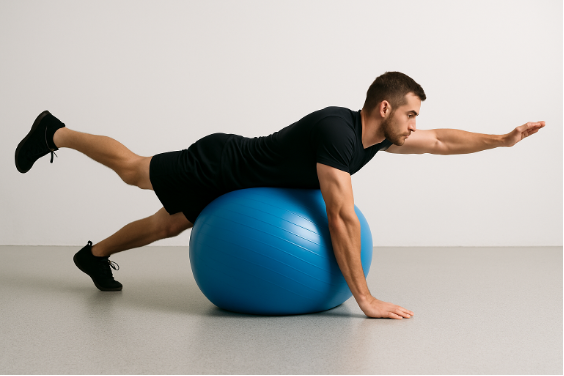
1. Bird Dog on Exercise Ball
Purpose: Trains contralateral coordination, spinal control, and core-limb sequencing on an unstable surface.
Setup:
• Athlete lies with their stomach centered on a large exercise ball.
• Hands and toes are on the ground (quadruped-like stance).
• Core is engaged to maintain balance.
Movement:
• Extend opposite arm and leg.
• Hold for 3–5 seconds, then return to start.
Prescription:
• 3 sets of 15 reps (each side counts as one).
Coaching Cues:
• “Reach long, not high.”
• “Brace your core before you move.”
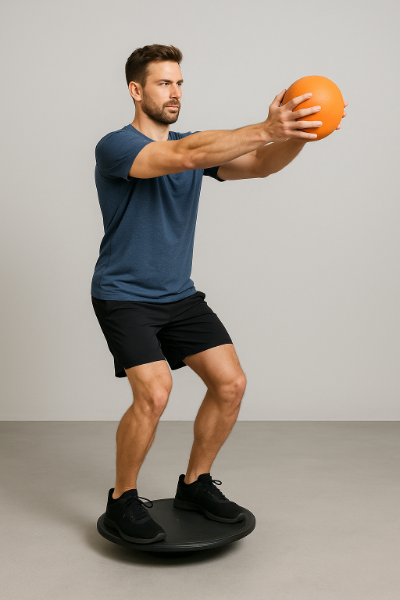
2. Wobble Board Balance with Medicine Ball Shoulder Raises
Purpose: Enhances postural stability, proprioception, and core-shoulder coordination.
Setup:
• Stand on a wobble board with feet shoulder-width apart.
• Hold a 4–6 lb medicine ball at waist level.
Movement:
• While balancing, perform forward or lateral raises with the ball.
• Avoid shifting hips or swaying.
Prescription:
• 1-minute balance hold minimum.
• 2–3 sets of 10–15 reps of shoulder raises.
Coaching Cues:
• “Stabilize from your core.”
• “Slow, controlled lifts.”
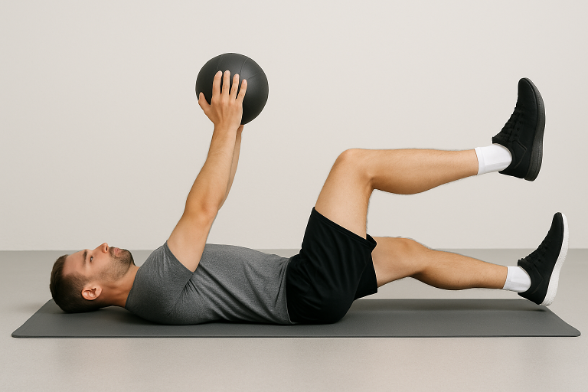
3. Supine Dead Bug with 4 lb Medicine Ball
Purpose: Activates deep core muscles and trains feedforward stability with light load.
Setup:
• Lie on back, knees bent 90°, arms extended holding 4 lb medicine ball over chest.
Movement:
• Phase 1: Hold the ball static while alternating opposite arm and leg.
• Phase 2 (Progression): Lower the ball overhead during the leg extension.
Prescription:
• 3 sets of 10–12 reps.
Coaching Cues:
• “Brace before every rep.”
• “Don’t let your back arch.”
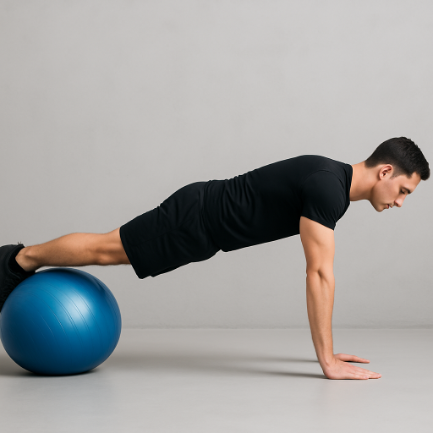
4. Stability Ball Plank (Feet on Ball)
Purpose: Builds tonic core endurance and enhances trunk stabilization under load.
Setup:
• Forearms on the ground, feet elevated on an exercise/yoga ball.
Movement:
• Hold a stable plank for 1 minute.
• Focus on minimizing hip movement.
Prescription:
• 1-minute hold, progress to 3 sets.
(balancing on forearms optional)
Coaching Cues:
• “Engage glutes and brace the core.”
Variation of the exercise can also be performed with a side plank as well. Use a bench if the ball is too unstable.