Sore or Injured?
Turf Talk: What Parents and Players Need to Know
During a long soccer season, feeling sore is normal.
With multiple practices each week, a long season, and frequent tournaments, most players are going to feel tight, achy, or fatigued at some point. That doesn’t mean something is wrong — it means their body is responding to the workload.
At the same time, not all pain should be ignored.
The goal for parents and players isn’t to panic every time something hurts. It’s to understand when soreness is expectedand when pain is signaling something that needs attention.
Soreness Is Part of Soccer
Soccer places repeated stress on the same muscle groups — hamstrings, quads, calves, hips. Over time, those tissues get tired before they get stronger.
Soreness usually:
Comes on gradually
Feels tight, achy, or heavy
Improves with movement and warming up
Does not stop a player from running or playing normally
This type of soreness is common during busy stretches of the season and usually settles with proper recovery.
3 Signs It’s Likely Normal Soreness
1. It Improves as the Player Warms Up
Players may feel stiff or tight at the start of practice, but once they’re moving, the discomfort improves.
2. It Feels More General Than Specific
Soreness is often felt in both legs or across large muscle groups rather than in one sharp, pinpoint spot.
3. Performance Still Looks Normal
The player can sprint, cut, jump, and kick without limping, hesitation, or changes in movement.
Soreness is uncomfortable, but it doesn’t usually change how a player moves.
Injury Is Different — and Usually More Specific
An injury isn’t just discomfort. It’s pain that interferes with function.
One of the biggest mistakes athletes make is assuming all pain is the same. Injury pain often starts subtly and then worsens when ignored.
Injuries tend to:
Be more localized
Persist instead of improving
Show up during specific soccer movements
3 Signs Pain Needs to Be Looked At
1. Pain That Doesn’t Improve Over Time
If a player has pain that lingers week after week — especially in the same area — that’s no longer normal soreness.
2. Pain With Acceleration or Deceleration
Pain that shows up when sprinting, stopping quickly, or changing direction is a red flag. These movements place high stress on muscles and tendons.
3. Pain That Affects Kicking or Sprinting
If pain increases with sprinting, kicking, or repeated efforts — rather than easing — it needs attention.
When pain changes how a player runs, kicks, or protects one side of their body, it’s no longer just soreness.
A Common Example: Hamstring Pain
Hamstring tightness and soreness are very common during the season, especially with long practices, repeated sprinting, and frequent games. Most of the time, this type of soreness improves with warm-up and recovery.
However, when hamstring pain becomes chronic, meaning it does not improve over time or keeps returning, it should not be ignored.
If a player has hamstring pain that:
Persists for more than a couple of weeks
Shows up during acceleration or deceleration
Is painful when kicking
Gets worse with sprinting
That is no longer normal soreness.
Continuing to push through in this situation can turn a manageable issue into a true hamstring strain, which often means 4–8 weeks away from full play.
The goal is not to scare players, but to catch the issue early. Addressing hamstring pain sooner usually shortens recovery time and helps players return stronger, rather than sidelined for a month or more.
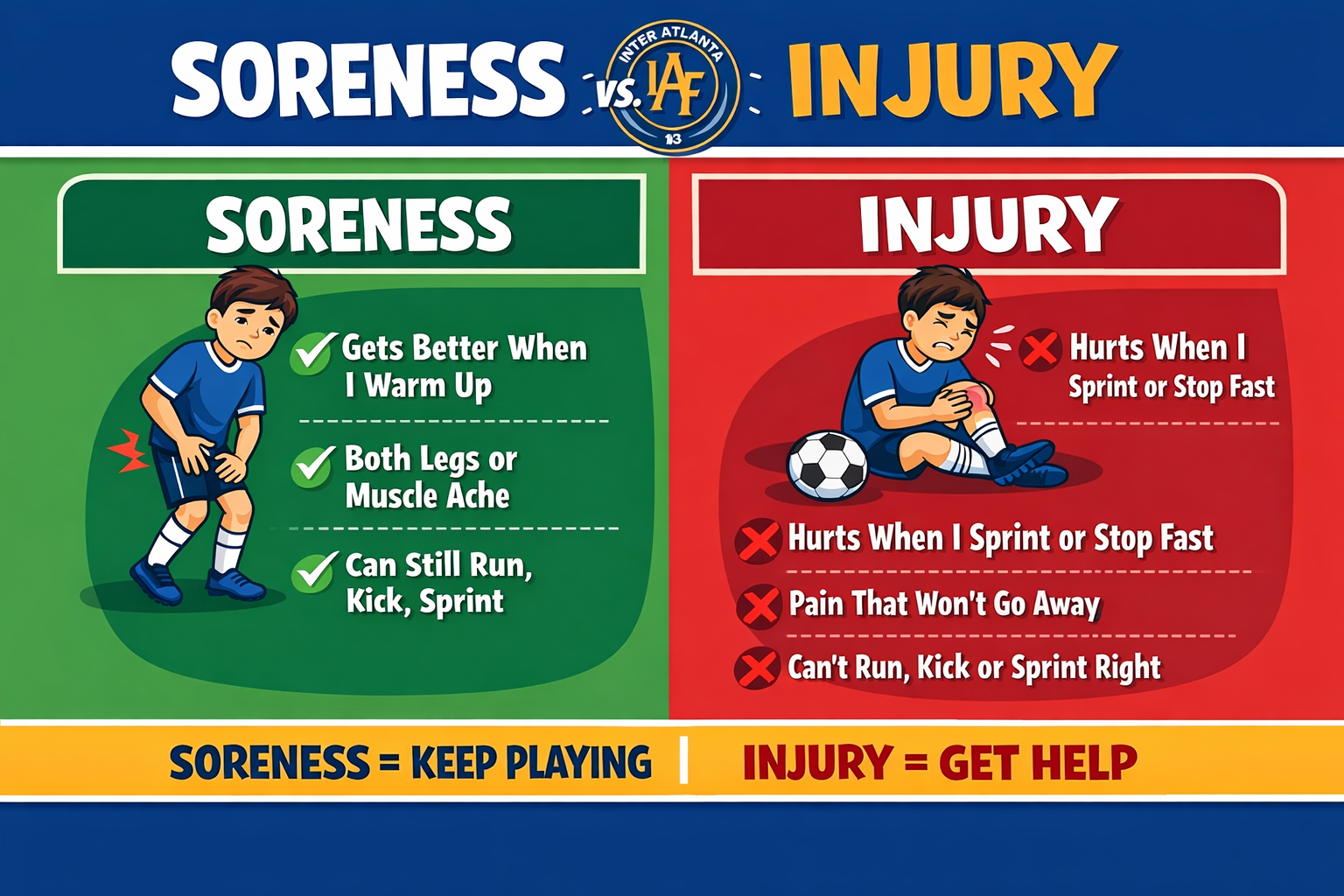
Soreness vs. Injury
Why This Matters During Busy Seasons
During spring especially, many players are juggling:
Three or more practices per week
Two or more games each weekend
Tournaments with limited recovery time
This makes soreness common — but it also increases the risk of ignoring early injury signals.
Playing through soreness is usually safe.
Playing through injury is how players miss extended time.
A Simple Guideline for Parents and Players
Pain is likely soreness if it:
Improves with warm-up
Does not change speed or confidence
Feels more like tightness than sharp pain
Pain should be checked if it:
Persists week after week
Appears during sprinting, stopping, or kicking
Changes how the player moves or competes
Parents don’t need to stop everything at the first ache — but patterns should never be ignored.
The Takeaway
Soccer is demanding, and soreness is part of the game. Kids should not worry every time they feel tight or achy.
At the same time, learning to recognize when pain is no longer normal is one of the most important skills a young athlete can develop.
The goal isn’t to get through one weekend — it’s to keep players healthy, confident, and on the field long-term.
That’s how development really happens.