The Weighted Vest Craze: Is Your New Weighted Vest a Health Hack or a Spinal Trap?
If you’ve walked through your neighborhood lately or scrolled through social media, you’ve likely seen it: the "weighted vest." Once reserved for elite athletes and military training, these sleek, sand-filled vests are now the hottest accessory for busy moms and "housewives" looking to turn a trip to the grocery store or a walk with the stroller into a high-powered workout.
The promise? Better bone density, faster weight loss, and "functional" strength.
But as a chiropractor, I have a different question: Is your spine ready for the extra load? When we add weight to the human frame, we are essentially "turning up the volume" on our existing posture. If your posture is a beautiful symphony, the vest is an amplifier. If your posture is a bit "out of tune," the vest makes that disharmony much louder—and potentially much more painful.
The Pros: Why Everyone is Wearing Them
There is real science behind this trend. As we age—particularly for women in the perimenopausal and menopausal years—bone density becomes a "use it or lose it" asset.
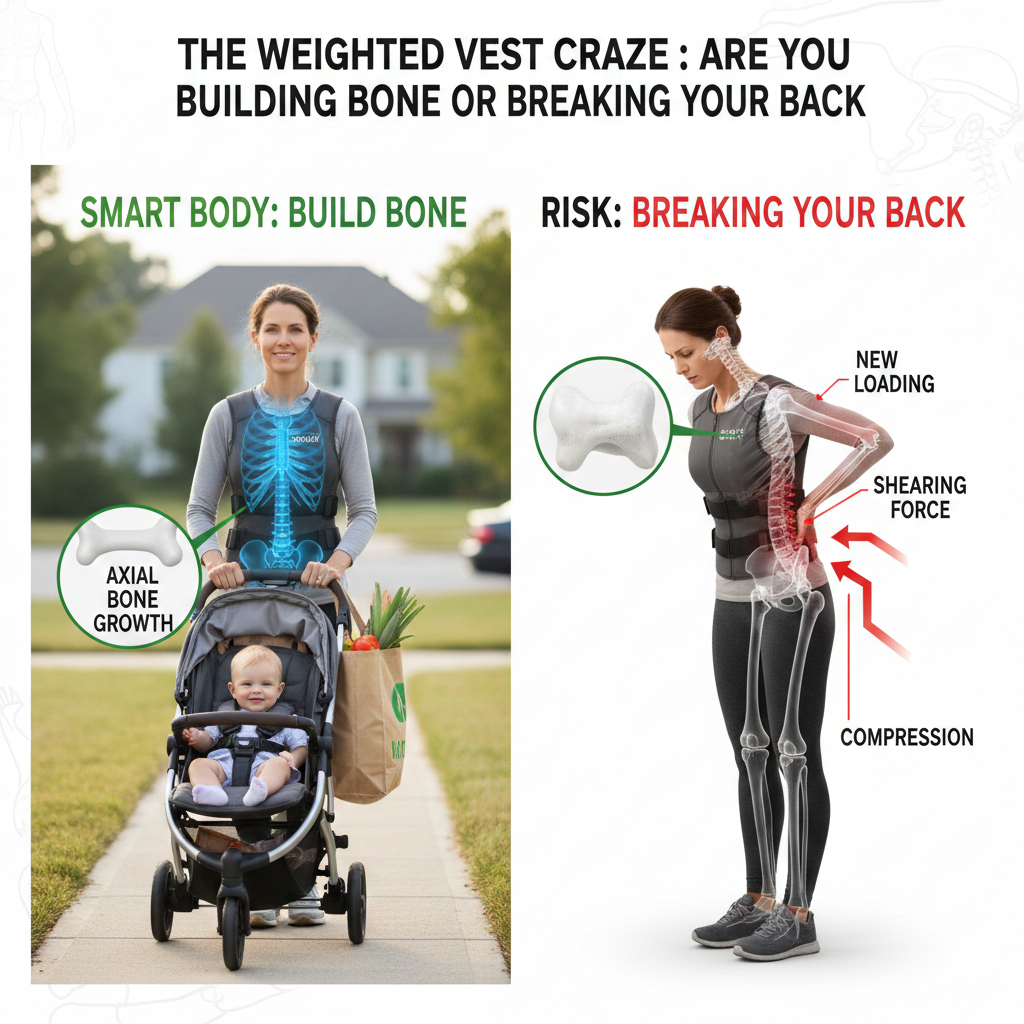
Osteoporosis Prevention: Your bones are living tissue that responds to stress. Weighted vests provide "axial loading," which signals your osteoblasts to build more bone to handle the demand.
Metabolic Boost: By adding just 5% to 10% of your body weight, you increase your caloric burn without needing to run or jump, which is easier on the joints... if your alignment is correct.
The "Secret" Cardio: It turns a simple walk into a Zone 2 cardio session, improving heart health while you’re simply going about your day-to-day duties.
Are weighted vests worth it?
The Expert Consensus: What the Internet is Saying
I’m not the only one watching this trend closely. Across the medical field, experts are weighing in on the "Rucking for Women" movement:
Dr. Kristen Beavers (Wake Forest University): Research suggests that incorporating weighted vests can help preserve bone density and improve balance, particularly in postmenopausal women. The strength of the data lies in the consistency of these benefits across multiple small studies.
Dr. Melissa Calcei (Sports Medicine): She emphasizes a "safety-first" approach, warning that users must work on flexibility and dynamic movement before strapping on a vest. The goal is to make workouts harder, not to increase the risk of injury through poor form.
The Harvard Health Perspective: Most experts agree that you should never exceed 10% of your body weight. Going heavier doesn't necessarily build more muscle—it just increases the risk that the "cons" will outweigh the "pros."
The Cons: The "Hidden" Risks to Your Spine
While the benefits are real, adding weight to a dysfunctional frame is a recipe for injury. Here is what I’m seeing in the clinic:
1. The "Forward Lean" Trap If you already struggle with "Text Neck" or rounded shoulders, adding a weighted vest can actually exacerbate the problem. Your body may compensate for the front-heavy weight by leaning forward even more, putting massive pressure on the L4 and L5 discs in your lower back. This creates a "shearing" force that the spine wasn't designed to handle.
2. Compressing the "Spring" Think of your spine like a shock-absorbing spring. If that spring is already "kinked" (what we call a subluxation), adding 15 pounds on top doesn't strengthen it—it compresses it. This can lead to nerve irritation and sciatica. You wouldn't put a heavy roof on a house with a cracked foundation; your spine is no different.
3. The Gait Shift and Pelvic Torque Extra weight changes how your feet hit the ground. If your pelvis is slightly rotated—common if you often carry a child on one hip—a weighted vest can turn a minor "hitch" in your walk into a chronic knee or hip issue. The weight forces your muscles to work harder, but if they are firing asymmetrically, you are simply "strengthening a dysfunction."
Smart Body Guide: How to Choose and Use
If you’re going to join the movement, do it with "Smart Body" intelligence. Not all vests are created equal:
Avoid "One Size Fits All": Look for vests with adjustable straps that sit high on the chest. If the weight hangs too low or bounces, it creates a "pendulum effect" that pulls your vertebrae out of alignment.
Even Distribution: Ensure the weight is balanced equally between the front and back. A front-loaded vest will pull you into a slouch; a back-heavy vest will make you arch your lower back excessively.
Listen to the "Niggles": In my 15 years of experience, I’ve learned that "niggles" are the body’s early warning system. If you feel a pinch in your hip or a tightness in your jaw while wearing the vest, take it off immediately.
The Smart Body Checklist: Do This Before You "Vest Up"
Rule 1: Earn the Weight. You should have a pain-free, full range of motion before adding external load.
Rule 2: Start at 5%. If you weigh 150 lbs, start with 7.5 lbs. Let your tendons and ligaments adapt before your bones do.
Rule 3: Get an Alignment Check. This is the most important step. As your chiropractor, I can ensure your "foundation" is level. Adding weight to a balanced spine is a superpower; adding it to a crooked one is a liability.
The Verdict
I love the weighted vest trend for its focus on longevity and bone health. It is a brilliant way to stay "Smart Body" fit in a busy world. But remember: Load reinforces movement. If you move poorly, the vest reinforces poor movement. If you move well, the vest reinforces excellence.